

Playbook Kits
A Community-Based Prevention Pilot for Military Families

A proven community-health model, brought for the first time to the families who need it most, by the people who live it.
SPONSORED BY

2019
For decades, military spouse distress was invisible in the data
The Department of Defense only began reporting on military family suicide in 2019. Until then, nobody was counting. Now that we can finally see the numbers, they are sobering.
133
military spouses died by suicide in 2020, with firearms the leading method. DoD Annual Report on Suicide in the Military
36.6%
of spouses with a deployed partner develop a mental health diagnosis. Mansfield et al., NEJM, 2010
1 in 8
screen positive for major depression, and 1 in 6 for generalized anxiety, nearly twice the civilian rate. Cole et al., 2021
Military spouses are not at greater suicide risk than civilians, and this proposal makes no such claim. The point is simpler. A whole population carried this weight without anyone watching, and the forces behind it (isolation, solo parenting, thin support) are exactly what this program is built to reach.

When the car pulls away, she becomes everything
She becomes the only parent, the only earner, and the only steady adult in a house full of worried children, often with very little support around her. Clinicians see this picture every day, and the research describes the same one.
+39
excess cases of depression appear for every 1,000 wives over an eleven-month deployment. Mansfield et al., NEJM, 2010

~2×
Child maltreatment roughly doubles after a deployment begins. The increase comes from neglect rather than abuse; these are exhausted parents, not dangerous ones. Rentz et al., 2007; Gibbs et al., JAMA, 2007
Children's depression and behavioral symptoms are predicted by the non-deployed parent's mental-health
Drummet et al., 2003 · Flake et al., 2009
The mother is not just struggling
She is the intervention
Steady her, and the research says the children steady with her. Everything in this program is built on that single fact.
A proven idea from community health: the promotora.
A promotora de salud, a "health promoter," is a trusted lay member of a community, recruited from that community, then trained and paid to bring health education, peer support, and system navigation to her own neighbors.
She is not a clinician and never pretends to be one. She is the bridge: she reaches the people the clinic can't, normalizes asking for help, catches problems while they're still small, and hands real crises to professionals.
The model grew out of Latin American community health traditions and has run in U.S. Latino and border communities for decades. Today it is mainstream public health: the broader term is community health worker, and the promotora is its best-studied form.
Dr. Reintjes did not find this model in a literature review. She began her career in schools and in the Latino community, watching promotoras work firsthand, and carried what she learned into two family-based prevention research projects, years of training district school counselors in suicide prevention, and the clinical lens she brings to this program.
It's the difference between asking a struggling family to come find the system, and sending someone they already trust to find the family.
40
Forty years of federal proof. We're just changing the address.
This is the de-risking argument, said plainly: USAA is not being asked to bet on a new idea. It is being asked to fund the first faithful translation of a proven one.
NIH
SAMHSA
Recognizes peer-delivered services as an evidence-based practice in behavioral health and has funded promotora-based mental health programming. The 40-hour advocate curriculum in this proposal is built on a SAMHSA-recognized peer-delivery framework. That isn't decoration; it's lineage.
CDC & HRSA
Has funded promotora and community-health-worker trials across dozens of conditions, from diabetes self-management and blood pressure to cancer screening and depression care engagement. The consistent finding: outcomes improve when a trusted community member delivers the education, the follow-up, and the navigation.
Both promote integrating community health workers into chronic-disease and primary-care programs, and CHW services are increasingly reimbursable under Medicaid. This is a workforce category the federal government already believes in.
And the evidence base is presented honestly. The literature isn't uniformly positive. The bestknown wrinkle is a depression trial (Ell and colleagues) that returned a null result, which the trial's own analysis traced to comparison-arm contamination: the "usual care" group effectively received pieces of the intervention, flattening any measurable difference. One muddied trial doesn't undo the broader pattern, and it is included in our evidence brief deliberately, because an evidence base should inform, not sell.

Five structural ingredients.
The model succeeds wherever these five conditions hold, and it is these conditions, not demographics, that decide whether it transfers.
01
02
Trust
She is already inside the community. The door is open before she knocks.
03
Stigma reduction
Talking to a peer isn't "getting treatment." It's a conversation. People accept help they would never go looking for.
04
Barrier navigation
She has personally survived the system she is helping others through.
05
Cultural concordance
The helper shares the lived culture of the helped. Nothing needs translating.
Cascade reach
Train one and she trains and touches many. The model scales through people, not buildings.
Military spouses are natural promotoras
Nobody had ever built the program
The model lives in public health. The military-family world lives in clinical and nonprofit services. The two literatures rarely speak, and it took someone standing in both worlds to see the match.
Walk the five ingredients across.
The argument is not that military families resemble the Latino community demographically. It is that they share the exact structural conditions the model was built to solve.
THE INGREDIENT
THE MILITARY-SPOUSE REALITY
Concordance
Military life is a genuine culture: PCS, deployment rhythm, OPSEC, the unspoken rules. A fellow spouse needs no translation; she has lived every transition the family is facing.
The elegant part: "The thing that breaks military families' care — the PCS move — is the thing that spreads ours."
One more inherited strength: the promotora model was always also an employment intervention for the women delivering it. With spouse unemployment near four times the civilian rate, the workforce return isn't a side effect. It is the second half of the model.
Trust
Installation communities are tight and wary of outsiders. A peer spouse isn't an outside provider showing up. She is already at the same school pickup line.
Stigma
Families fear that seeking care threatens the service member's career or clearance. Peer support lives outside the medical record entirely.
Navigation
Thirty-day waitlists, the TRICARE maze, care that severs with every move. The advocate has personally navigated all of it. That is her qualification.
Navigation
Every PCS move relocates a credentialed advocate to a new installation, seeding the model wherever the military sends her.
FOR THE MOTHER
The Playbook Guide
FOR THE CHILD
Military figurines
Printed to mirror their own family. Symbolic play lets them work through what they cannot yet say.
Playbook Kits
Co-regulation coaching in plain language. It teaches her to steady herself first, so she can be present.
Words for the hardest moments
Scripts for moving day, deployment night, meltdowns, and homecoming.
Employment
A portable career that honors her skills and fits military life.
Community
The promotora network of trained military spouse leaders, built to end isolation.
Sensory tools
When words fail, hands work. These meet distress in the body first.
A tactical backpack
Ownership and agency. A child in control of something can tolerate transition.
The Tracey Lucy insert
Hand-drawn art that says safety and belonging before any words do.
THE CLINICAL ARM: THREE TIERS, ONE NUMBER TO CALL
I. Universal stabilization. The kit and the caregiver coaching reach all 100 families.
II. Advocate-led groups. Trained military spouse advocates run play-based groups and quietly watch for signs of distress along the way. This is the early-detection layer.
III. Clinical escalation. If a family shows acute distress, they step directly to Dr. Reintjes. The pre and post assessment calls serve the family and the program's outcome data at the same time.

Built by people who live the mission
Every member of this team shares the military-family experience, the clinical mission, or both. Each engagement is scoped, budgeted, and named in the project workbook.
Mala Goodman, MPH
Strategy & Operations
MBA candidate, UNC KenanFlagler (Dec. 2026); MPH, George Washington University; Task Force 51/5 Ombudsman; military spouse and mother.
Twelve-plus years leading teams and operations across healthcare and technology, from Fortune 5 firms to startups. She keeps the program on time and on budget.
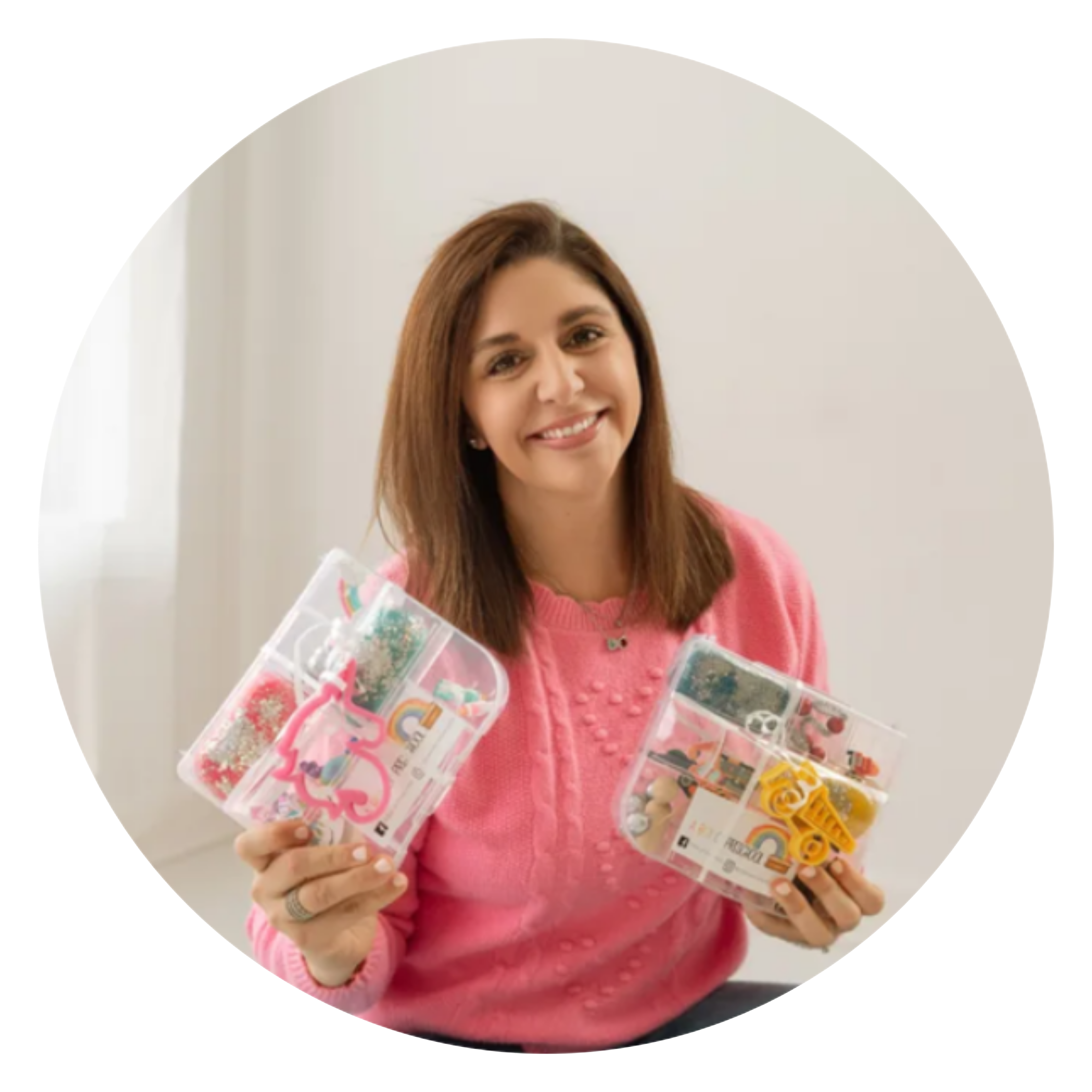
Andrea Fullmer
Kit Production & Sensory Materials
Founder of A Box of Preschool, a sensory play-kit business grown from her years as a pre-K teacher and her life as a military spouse and mother of three.
Andrea produces the program's 3D-printed tools and sensory components. Her work has been featured in St. Louis Magazine.


Elizabeth Burgin, PhD, LPC
Clinical Research Advisor
Military Behavioral Health Child Counselor at the Center for Deployment Psychology, Uniformed Services University, supporting the DoD Child Collaboration Study.
Former Assistant Professor leading William & Mary's Military & Veterans Counseling Program. Certified Child-Centered Play Therapy Supervisor; trained in CPRT, IFS, and EMDR. Military spouse.
Tracy Beagan
Pattern & Print Design · TracyLucy Designs
Surface pattern designer (Syracuse University) and former New York bedding designer whose brand work includes Laura Ashley, Nautica, Tommy Bahama, and Nicole Miller.
A military spouse and mother of three, Tracy creates the hand-drawn, IP-owned prints that give every kit its sense of belonging.
Clinical leadership: Dr. Monica Reintjes, PhD, LPC, RPT, Principal Investigator — profile on page 2 and throughout.
The economics of serving military families are broken.
A doctoral-level clinician who loves this population, and who is often a military spouse herself, nets only what's left of TRICARE reimbursement after overhead and supervision. She cannot raise a family on that, so she leaves for work that pays. Meanwhile, military families wait a month for a behavioral health appointment while the clinicians who want to serve them sit out.
What TRICARE pays
$44–57
per hour, net to a doctoral clinician after overhead. It is below what makes financial sense.
What Grant Funding sustains
$175–200
per hour. Rates like these bring her back, along with research capacity and publishable outcomes.
Grant funding doesn't just buy services. It rebuilds the workforce that wants to serve.
ALREADY WORKING, WITHOUT FUNDING
This exceeded my expectations. The step-by-step activities help foster connection with young children surrounding separation.
— Ashley, beta family
I love the explanation of parents as therapeutic agents. We have tangible tools.
— Clare, beta family
Two years, mapped task by task.
YEAR ONE — BUILD, LAUNCH & BASELINE
M 1–2 → Execute consultant and partner agreements; finalize advocate job descriptions; open recruitment across target installations
M 1–3 → Finalize manualized protocols and the measurement battery; lock kit insert art and the print package
M 2–3 → Deliver the 40-hour curriculum; credential five Community Health Advocates
M 3–5 → Produce 3D-printed tools and sensory components; assemble 100 Playbook Kits
M 4–6 → Enroll 100 families through base networks; distribute kits; collect baseline measures
M 7–12 → Run Tier 1 and Tier 2 continuously; advocate supervision; midpoint quality assurance on validated scales
M 12 → Interim Impact Report delivered to the USAA Foundation
M 16–18 → Group-supply replenishment; community engagement events
M 19–21 → Post-intervention data collection; begin three-to-six-month followups
M 21–23 → Pre/post and ROI analysis; manuscript and federal funding package drafted
M 24 → Final Comprehensive Impact Report and a scale-ready replication blueprint
Reintjes · Burgin · Beagan
Reintjes (Burgin advising)
Fullmer · Beagan
YEAR TWO — SUSTAIN, EVALUATE & SCALE
M 13–18 → Sustained Tier 1 and 2 delivery; fidelity monitoring; advocate development; Tier 3 escalations as needed
Reintjes · Goodman
Advocates · Goodman
Reintjes · Advocates
Reintjes · Goodman
Reintjes · Burgin
Fullmer · Advocates
Advocates · Burgin
Reintjes · Burgin
Reintjes · Goodman
$664, 781
over twenty-four months
THE ASK
100 military families served at no cost to them, and 5 military spouses employed and credentialed.
The investment funds:
100 comprehensive Playbook Kits, given to families free of charge
5 military spouses hired, paid, and credentialed through a 40-hour curriculum, building a career that survives every move
Advocate-led groups, with a direct clinical line to Dr. Reintjes behind them
A named expert team under contract: clinical research advising, operations, kit production, and print design
A rigorous pre and post evaluation that produces publishable, federally fundable outcomes
An Interim Report at Month 12 and a Final Report at Month 24
The return. The cost works out to $6,648 per family, and falls to roughly $3,554 if a second cohort is added. A single pediatric psychiatric stay, suicide attempt, or maltreatment case avoided would, on its own, repay much of this prevention investment. The program needs to prevent very few crises to break even.
For forty years, this model reached
communities the system couldn't
Military families are next.
Dr. Monica Reintjes, PhD, LPC, RPT
Principal Investigator, Playbook Kits
SPONSORED BY